

Listening and belonging at work

I See You

15 minutes that open space for listening within teams. An awareness action for companies that supports psychological safety at work.

Prefer to bring it to your parish? See the parish version →

Help Line Global

Befrienders Worldwide, Global Suicide Prevention, with QR code to befrienders.org

Find a helpline in your country

The I See You film crew pointing at the camera in front of the film's panel

Psychosocial risks at work need a place to be spoken. I See You creates it.

Psychosocial risks at work need a place to be spoken. I See You creates it.

I See You in Companies | Active listening at work. Running time: 1'08". October 27, 2026.

I See You in Companies

What if the greatest psychosocial risk in your company were not in the report, but in the conversation no one had the courage to have?

I See You in Companies is a 60-minute session for teams, leaders and HR, built around the 15-minute short film I See You.

I See You. Running time: 14'59".

Watch with subtitles in your language

The film is in Portuguese and has subtitles in 19 languages, including English and Spanish.

  1. Press play and click the CC icon (subtitles) in the bottom bar of the video.
  2. Click the gear icon (Settings) › Subtitles/CC and choose your language.
  3. On a phone, tap the video, then the ⋮ or gear icon › Captions.

Tip: if you open the video on YouTube, the same menu is available there.

The short film

What happens when someone is truly heard.

I See You is a 15-minute short film about what happens when a person is truly heard. At work, it opens a safe, plural and judgment-free space for the team to talk about what weighs on them and what sustains them. It was made to open a conversation, not to close one.

Psychological safety and psychosocial risks at work

Psychological safety begins when the risk can be spoken.

In the United States there is no specific federal standard on psychosocial risks at work. OSHA relies on the General Duty Clause, which requires employers to provide a workplace free from recognized hazards, and offers general guidance on workplace mental health. Many organizations go further on their own, building psychological safety into their culture and their risk management. Among the factors usually discussed:

  • Overload
  • Pressure for results
  • Communication failures
  • Conflicts
  • Leadership style
  • Lack of support
  • Isolation

This action does not replace a workplace risk assessment, occupational health and safety services, an employee assistance program or psychological care, and it does not promise compliance with any legal requirement. It is an action for awareness, for promoting listening and for strengthening belonging at work.

Cine-Talk · Cinema, dialogue and transformation

How it works in your company

1

Watch

The team watches the short film together, in a light and respectful atmosphere.

2

Talk

Then comes a circle conversation guided by an internal facilitator, with active listening.

3

Welcome

No one is required to speak, and no one needs ready-made answers. The conversation begins with presence and listening.

60-minute session: 15 for the film, 5 for silence, 30 for the conversation circle and 10 for closing.

  • Groups of up to 20 people
  • No one is required to speak
  • Circle confidentiality
  • Not therapy
Who it is for

For those who care for teams.

  • Leaders and managers
  • HR and human development
  • Occupational health and safety
  • Teams and units
  • Culture, well-being and ESG programs
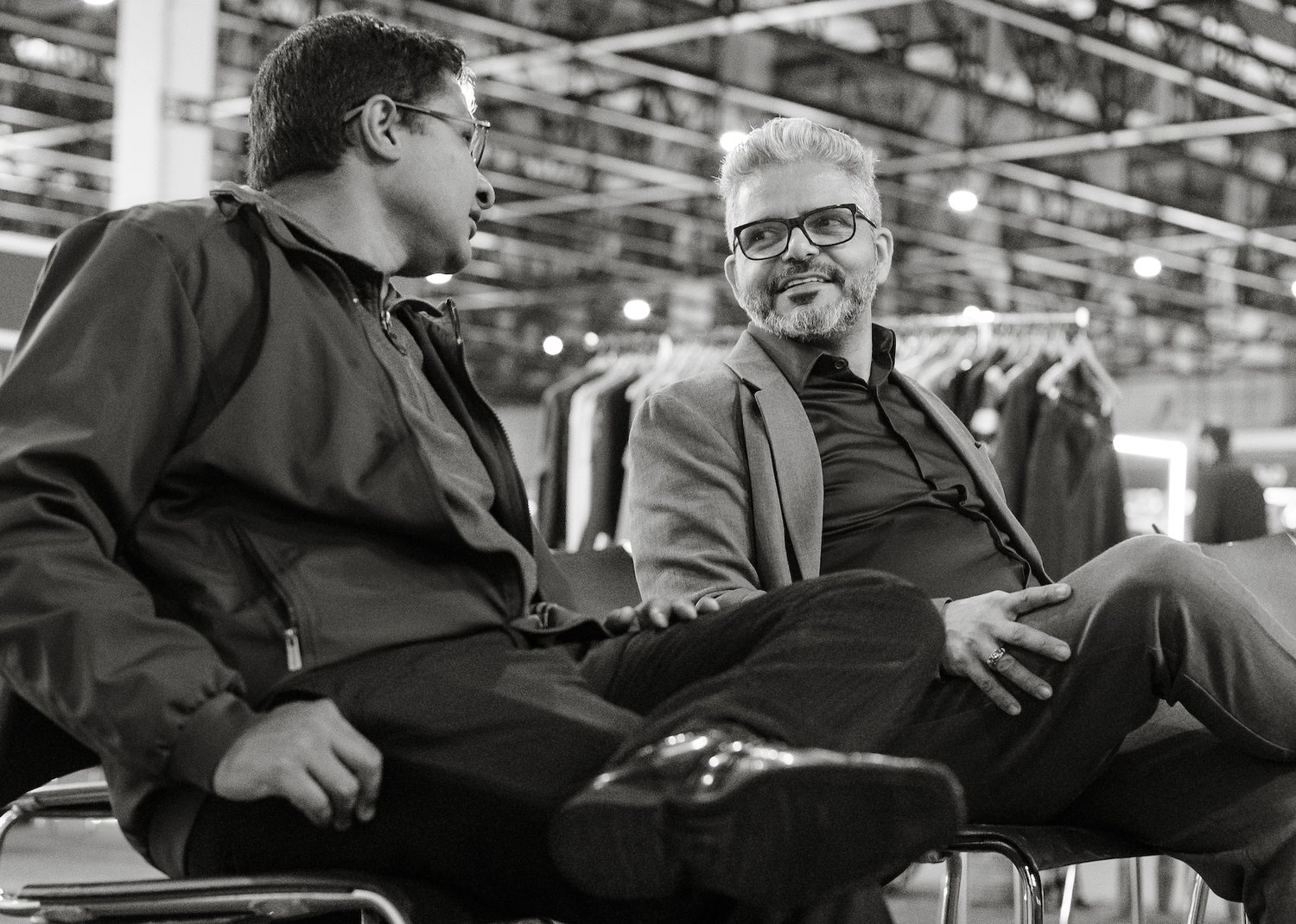
Two men talking, seated side by side in a large pavilion, in black and white
Wesley Meoli speaking into a microphone at an event, wearing a green blazer, with a phone in his other hand
Contracting

Paid screening, with an anonymized report.

In companies, the screening is paid and includes an anonymized post-circle report, which helps turn listening into action. The report includes:

  • the number of participants;
  • emerging themes, without identifying people;
  • suggested next steps;
  • recommendations for the company's risk plan.

Corporate screenings make free parish screenings possible and support the mission.

In parishes, the screening remains free and missionary.
Keynote with the director

Want the director speaking at your event?

Wesley Meoli presents the keynote The Power of Your Story, on conscious communication, active listening and the power of narrative. For companies and conferences, with or without the screening of the short film.

See the keynote →

Circle guide for companies

A listening circle after the screening of the 15-minute short film. For those who lead the conversation in teams, HR areas, leadership and occupational health and safety.

What it is for

The short film opens the conversation, and this guide helps sustain it with care. The goal is not to solve anyone's pain or to offer ready-made answers. It is to create a place where people can be heard. The starting point is presence, and answers, if they come, come later.

Before you begin

Set aside about 60 minutes.

  • Arrange the chairs in a circle, with soft lighting. Groups of up to 20 people.
  • Define the internal facilitator and the company's support channel, to accompany anyone who needs more support after the circle.
  • Keep at hand the channels in the section “If someone needs more help.”
  • The person leading announces that the conversation is not therapy and does not replace professional care.

Circle agreements (read aloud)

  1. No one is required to speak. Passing is also a way of taking part.
  2. Each person speaks for themselves, without being interrupted, advised or judged.
  3. Silence is welcome.
  4. We do not compare one pain with another.
  5. What is shared here is not discussed outside the circle. Confidentiality.
  6. The circle is not a place for performance evaluation or for handling individual cases. Those have their own channels.

Layered questions

Start with the first and move forward only if the group is comfortable. Any question can be answered with “I'd rather not answer.”

  1. Which image, scene or line from the short film stayed with you?
  2. At what moment of your work week do you feel seen? And at what moment do you feel that no one notices?
  3. What tends to go unsaid among us, on the team?
  4. What would make our team a safe place to say “I'm not okay”?
  5. For leaders — Who takes care of those who lead here?

How to lead

Do

  • Reflect back what you heard in simple words, such as “That sounds like it weighs heavily” or “Thank you for trusting the group with this.”
  • Accept silence without filling it.
  • Thank each person for speaking, without evaluating.
  • If someone cries, wait. There is nothing to fix.

Avoid

  • Giving advice, diagnoses or quick solutions.
  • Saying “It comes with the job,” “Everyone goes through this” or “It could be worse.” These phrases can silence and wound.
  • Asking someone to share more than they chose to.
  • Demanding names, departments or examples that identify people or managers.
  • Promising that everything will be fine.

If someone needs more help

The circle welcomes, but it has limits. Seek professional help when the person:

  • cannot carry out daily activities;
  • seems to have lost touch with reality;
  • talks about hurting themselves, taking their own life or hurting someone else;
  • depends significantly on alcohol or other substances.

Support channels

  • The company's listening or reporting channel, for work-related situations.
  • The company's or health plan's network of psychologists, for ongoing care.
  • The nearest public or community mental health service, for regular follow-up.
  • In the United States, call or text 988 (988 Suicide and Crisis Lifeline), free and available 24 hours a day.
  • If you are outside Brazil, contact your local crisis service or find your country's helpline at befrienders.org.
  • Your local emergency number (911 in the United States) or an emergency room, if there is immediate risk. In that case, do not leave the person alone.
  • In Brazil: CVV (188, cvv.org.br) and SAMU (192).

What to do

  • Talk in private, calmly and without making a scene. Ask, and listen.
  • After the referral, stay close with a conversation or a visit. Care does not end with the referral.

Help Line Global

Befrienders Worldwide, Global Suicide Prevention, with QR code to befrienders.org

Find a helpline in your country

Caring for those who lead

The screening can be held only with leaders, managers and HR teams. Those who lead others also carry weariness and do not need to hide it. In that case, use question 5, set aside more time for the circle and agree on a next meeting.

Closing

  • Thank everyone for their trust.
  • Remind them that the conversation can continue in private with anyone who wishes.
  • If it makes sense for the team, end with a moment of silence or a brief, optional pause, without requiring everyone to take part.
  • Repeat the support channels.

This action does not replace a workplace risk assessment, occupational health and safety services, an employee assistance program or psychological care, and it does not promise compliance with any legal requirement. It is an action for awareness, for promoting listening and for strengthening belonging at work. It is not therapy.
Eu Vejo Você®. Instagram @olaeuvejovoce | euvejovoce.org

Frequently asked questions

How does the Cine-Talk work in organizations?

It is a 60-minute experience combining a short film, silence, guided dialogue and a closing, focused on active listening and reflection on human relationships at work.

Does the Cine-Talk replace a psychosocial risk assessment required by Brazilian regulation (NR-1)?

No. It is a complementary awareness and dialogue action. It does not replace the technical identification, assessment, prevention or management of psychosocial risk factors, or the organization's legal obligations, and it does not guarantee compliance with Brazil's NR-1 or any other regulation. It is not an equivalent of OSHA requirements or of any certification.

Does the company receive a report?

The corporate screening includes an anonymized post-circle report that consolidates what was heard into themes for the organization. Scope and confidentiality limits are agreed in the proposal, and absolute anonymity is not promised.

Is the corporate session free?

No. Corporate screenings are paid, and commercial terms are provided in the proposal. Corporate bookings help make free parish screenings possible.

Let's talk

Want to bring it to your company?

Tell us the size of the team and the context, and we will send a proposal with format, date and post-circle report.

Or write to [email protected]